A Simple Plan (shame if something happened to it…)

What goals do you have for the autumn season? According to my bullet journal, mine are simple:

  • Don’t touch the MS for Project Arcade until Oct. 1!
    Research methods for revising novels (Sep 30)
    Read Story Genius
    Re-Read 2k-10k
    Google search for blog posts (Fiction University)
    Play Dragon Age: Inquisition for background and feel for Project Arcade (no deadline)
    READ PROJECT ARCADE (Oct 1)
    Make a revision plan for Project Arcade (Oct 4)
    Ask 3 people to be critical readers for Project Arcade (October 15)
    Make it up to 50 queries submitted for WITCHMARK (october 15)
    Revise Project Arcade, round 1 (November 15)
    Revise and edit Project Arcade, round 2 (December 15)
    Plan Winter 2017 goals (December 22)
    Reading Break (December 31)

This is pretty much in order. It also focuses exclusively on stuff I can control. For example, I wrote “query more agents to a goal of 50” because I can do that myself. “Find an agent to represent me” depends on other people.

I also have a lot of freedom with my plan. I have set deadlines, but they’re just for me, as I’m not under contract for anything. I am super comfortable with my deadlines, and if nothing happens to disrupt my plan, I’m going to have a contemporary romance ready to query when publishing re-opens in January.

The only problem is if something happens to wreck my beautiful plan, like say getting a response on WITCHMARK that means I have to hold off on Project Arcade. Then I’ll have to do it over, but honestly, that would be a nice problem to have.

How do you plan ahead for writing?

Our Point of View on POV

rwchat-sept-18-email

Since everyone has a different POV on POVs, we thought we’d give you the four POVs of our #RWChat hosts.

“I write dual POV in very close third person,” says KIMBERLY BELL. “I choose dual because I like having the perspective of both of the romantic leads in my story. It allows me to play with misunderstandings and have a bit more flexibility in a character’s behavior because the reader understands the why. I write close third because…writing in first person feels weird to me? I need that little bit of distance to feel like an observer rather than like it’s MY story—but I write third very close, because I enjoy playing with the internal thoughts of my characters and using them to really get you into their personalities.” 

“I’m flexible,” says C.L. Polk. “I’ve written in first person and third at varying narrative distances, but my most comfortable perspective is third person past, written as close to the skin as possible. I tend to limit the number of POV characters to no more than two, which works well for romance novels. Third person close is vivid and personal, and since I want people to connect to the story and characters, I don’t want to hold them at arm’s length.”

“A close third person POV was how I started writing,” says Robin Lovett. “I wrote three novels that way until I decided to try first person present tense to see if I could. As of now, my two first person POV books are the only ones that have sold.  For whatever reason, I’ve had no luck yet with my third person books. I enjoy present tense verbs in the first person because it makes everything feel more immediate and in-the-moment exciting. We each go with our strengths. It takes trial and error to find our voices.” 

“Before I admitted to myself that I wanted to write romance,” says Alexis Daria. “I used to write a lot more in first person (past tense). Now, I write exclusively in third person, but that might change in the future. Sometimes I’ll read scenes out loud to myself, converting them to first person present as I read, in order to get a deeper POV.”

Join us Sunday evening at 4pm PST/ 7pm EST and tell us what your POV is on POV.


Creating the Emotional Experience by Bronwen Fleetwood

We’re pleased to have a guest post this week by #RWChat regular, Bronwen Fleetwood!

You might think we read for artful plots, or to meet memorable characters, but both will fall flat if they don’t inspire emotions in the reader. This is especially true in romance, which promises to provide an emotional experience with a satisfying HEA. How to evoke emotion is a vast topic, but here are some tips to get your heart fluttering.

Identify the Emotion
What do you want the reader to feel? Anger at a character, joy at an outcome, sadness over a loss? For every scene, make a note to yourself of what the reader should be feeling. Some scenes may have more than one emotion, or have an emotional arc.

Create Empathy
Give your reader a reason to care about your character. The heroine’s dog died. That sentence doesn’t do very much for you, does it? The heroine’s beloved childhood companion, who faithfully followed her everywhere, died. The difference is that I set up the relationship between the heroine and her dog. Through the description we get a sense of how the heroine feels about the dog. When the character feels something, the reader can react to it, and feel something themselves.

Draw on Past Experience & Visceral Details
Actors are often told to draw on their past experiences to portray a scene more authentically. You can do the same. If your heroine is ecstatic, remember what it was like to be ecstatic yourself. What details stood out to you? How did you feel physically? Really dig into the visceral reactions you had. It’s these details that will make a reader say, “Yes! I’ve felt that way before!”

To learn more, check out 18 tips for Creating Emotion in the Reader, a guide to stimulus and Causes of Unemotional Writing & How to Correct Them, and Margie Lawson’s lecture series on Empowering Characters’ Emotions.

And don’t forget to join us for #RWchat this week!

Bronwen Fleetwood writes books for young adults, because those have always been, and often still are, the books that have made the biggest impact on her. She’s always been fascinated by fairy tales and myths, and always wanted to know why so many female characters get the short end of the stick in such stories–and in life in general. It must be all that “GIRL POWER” messaging in her youth. You can find her on Twitter @bronniesway or on bronwenfleetwood.com.

Reading as Research

DeathtoStock_Clementine2You know the feeling. You’re reading a book, and for some indefinable reason it completely sucks you in. When you finish, you seek out the rest of the author’s backlist, and devour them. Wow, you think. This is a really good book!

Great. We all love good books. But as authors, we also want to write really good books. The problem is, a really good book will make you forget you’re reading a story created in the imagination of someone who labored over a laptop for months at their kitchen table. It takes a lot of work to make a book read effortlessly. At the end of such a book, you’re left wondering, how did they do it?

Continue reading

Feedback – you can run from it but you can’t hide!

Submitting your work for feedback is like putting your heart in someone’s teeth. If you’re lucky, they’ll hold it gently in their hands. If you’re not so lucky, they’ll bite down and make it bleed. But if you’re REALLY lucky, they’ll take the time and effort to help your work be the best it can be, even if it means tough love. And there’s a reason why they call it tough – it ain’t easy to take.

But before we chat tonight about receiving feedback, I’d like a word about GIVING it. I admit, I didn’t know how to give it at first. I was one of THOSE people who coated others’ work with so many comments, it looked like a sea of red by the time I was done. I was brutal. And I definitely owe some people formal apologies for the feelings I hurt. I was new, and I didn’t understand what good feedback meant.

Here’s my understanding now of what good feedback means, or at least the kind I like to get:

Good feedback does not mean taking the person’s work and nitpicking it until you’re trying to make it your own. That’s not feedback, it’s rewriting, and it’s rude. (See the guilty sign on my back…)

Good feedback also does not mean sugar coating – telling someone glowingly how wonderful their work is without any critique. That is shallow and superficial and unhelpful. (I’ve done that too, out of laziness.)

Good feedback, great feedback, falls in the middle. It means taking the time and care to highlight in detail the strengths of a writer’s work. Because let’s face it, most of us don’t know what our strengths are, and it’s important that we know what we do well.

It also means giving the attention to make constructive, deliberate critiques. To look carefully at a writer’s work and find the potential that has yet to be realized. Great feedback is given with respect and wanting to bring the work to a higher level. It’s given with a belief in the other writer’s ability and the integrity of their story.  It’s investing the time and effort to uplift the work, not degrade it.

Great feedback is a giant compliment of YOUR WORK IS WORTH MY TIME. Accept it with grace, consideration, and discernment. Having the dedication to take every piece of it seriously is a hallmark of a great writer.

Given compassionately and well, great feedback is the foundation of building the great relationships we have going in this wonderful community of ours.

Looking forward to hearing your insights on receiving feedback!

See you at 7pm EST on #RWChat.

~Robin Lovett


Core Story—Wtf is that?

The first time I heard about core story, it was at RWA 15 in New York. I got to hear about it from my romance writer hero, Jayne Ann Krentz. (She’s pretty much the author and the person I want to be when I grow up, but we can fangirl about it another time, because Robin and Alexis will probably shank me if I don’t put a blog up soon.)

jayneannkrentz

Jayne Krentz is my hero. She can be your hero too, if you want. I’m willing to share.

If you follow Jayne at all, you know she has a boatload of pen names. Seven in total, although three are currently active. I found her through Amanda Quick, firmly solidifying my love of historical romance. She pioneered the futuristic/paranormal genre as Jayne Castle, and she freaking kills it under her own name writing contemporary suspense.

Hearing about core story from Jayne Ann Krentz was amazing because…homegirl knows. When you write that many genres under that many names, you find out who you are as a writer. You find out what the heart of the story you’re trying to tell is. I can’t remember what she said her core story was—she said it, I just can’t remember—and I’m not willing to tell you what I think it is. But I know what mine is, so I’ll tell you about that.

Continue reading

From Graphic Novel to Manuscript

Here at #RWChat we’re all about hearing other people’s stories, so we’ve invited Shea Standefer to tell us about her first novel, which started life in comic form.

~~~~~~~~~~~~~~~~~~~~~~

Shea Standefer author picHi, I’m Shea! I’ve been invited to write about how I took my idea for a graphic novel and turned it into a fully-fledged, #PitchWars-ready manuscript!
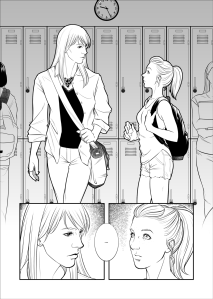
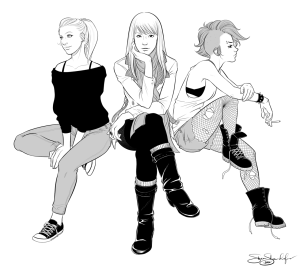
When I was in college, I was heavily into the comic book scene and I spent a lot of time doodling my own short stories. One class in particular led me to illustrating a 30-page comic, which ended up being the basis for my current manuscript, DEFINING LINES.

Continue reading

My Clique

Here at #RWChat we’re all about hearing other people’s stories, so we’ve invited LaQuette to tell us why having a writing community is so essential.

laquette

~~~~~~~~~~~~~~~~~~~~~~~~~~~~~~~~~~~~~~~~~~~~~~~~

As a writer I require solitude in order to write. Whether that solitude comes from locking myself into my office, or sitting on the couch with my ear buds in and music blasting as my kids play on the living room floor, it doesn’t matter. If I’m going to write, I have to hear my own thoughts to create.

Yes, I need solitude. However, I cannot be continuously alone and successfully tap into my creativity. What’s the difference? Solitude is taking a few moments without distraction to focus on my internal thoughts. Once my work for the day is done, then my need for solitude is completed as well. However, being alone means to have no one, at all, ever. This state of being perpetually alone can be unhealthy for the writer’s mind as well as career. If you’re going to succeed as an author, you’ve got to have a community, a tribe of your own.

Continue reading

The Beauty of Contests

Here at #RWChat we’re all about hearing other people’s stories, so we’ve invited Laura Brown to tell us why she’s participated in writing contests, as a writer and as a mentor.

web head shot square

~~~~~~~~~~~~~~~~~~~~~~~~~~~~~~~~~~~~~~~~~~~~~~~~~~~

I just love writing contests and have been involved on both sides: as an eager entrant and as a judge/mentor. The reason I’m doing the latter is because of how much I learned from the former.

Simply put: I owe everything to contests, directly or indirectly. Contests took me from writing in solitude, to meeting my first critique partners, to learning the basics of the craft. Many contests use twitter hashtags to spread information and knowledge. It’s an excellent way to learn and improve, even if not picked as a finalist.

Continue reading